
Expanding, Sticky, and Walking Wilds begin with the same basic role: they may substitute for paying symbols under the game’s rules. Their extra behaviour differs. An Expanding Wild covers more positions, a Sticky Wild remains in place for several rounds, and a Walking Wild changes position during a respin, tumble sequence, or later round as defined by the paytable.
The names are not complete rules. A Wild may be restricted to middle reels, stay only during Free Spins, or carry a multiplier. Read the active game’s Help screen before relying on its animation.

Start with the ordinary Wild rule
A standard Wild commonly substitutes for paying symbols to complete a win. Exceptions are normal: many Wilds cannot replace Scatters or Bonus symbols, and some appear only on selected reels.
Open the paytable and check four points:
- which symbols the Wild can replace;
- which reels can contain it;
- whether it works in the base game, Free Spins, or both;
- whether expansion, persistence, movement, respins, or multipliers apply.
The Wild versus Scatter guide covers their basic jobs. This guide focuses on what special Wilds do after landing.
When an Expanding Wild fills a reel
An Expanding Wild grows beyond its original position. It may cover an entire reel immediately, expand only when it contributes to a win, or work only on specified reels.
Koi Gate provides a clear official example. HABANERO says the Koi is an Expanding Wild that appears on reels 2, 3, and 4. A Koi also awards one respin (HABANERO Koi Gate, checked July 31, 2026).
A full-reel Wild may touch several paylines, but it does not make every line win. Symbols on the other reels still need to satisfy the stated line or Ways rule.
How long a Sticky Wild stays
A Sticky Wild holds its position while other spaces spin again. It may remain for a fixed number of respins, throughout Free Spins, or until the current feature ends.
BNG states that an Amulet landing during African Spirit Sticky Wilds Free Spins turns into a Wild and stays for the entire Free Spins feature (BNG African Spirit Sticky Wilds, checked July 31, 2026). That is one game’s rule, not a promise that every Sticky Wild lasts for a complete bonus.
During a demo, watch the spin counter and held position together. Check whether every Wild sticks or only Wilds created by a named symbol. A glowing frame is not enough evidence unless the Help screen explains it.
Where a Walking Wild moves
A Walking, Moving, or Roaming Wild changes position after a result. There is no universal direction or step count. Some move to an adjacent reel and award another spin; others relocate after a tumble.
Pragmatic Play describes the Roaming Wilds in Gates of Valhalla as moving to random positions after every tumble, with game-specific multipliers (Gates of Valhalla, checked July 31, 2026). This example must not be turned into a rule that every Walking Wild travels one reel left or right.
When the paytable uses Walking, Moving, or Roaming, look for four details:
- Does it move after a spin, win, or tumble?
- Is the direction fixed or random?
- Does movement award a respin?
- When does the Wild leave the grid?
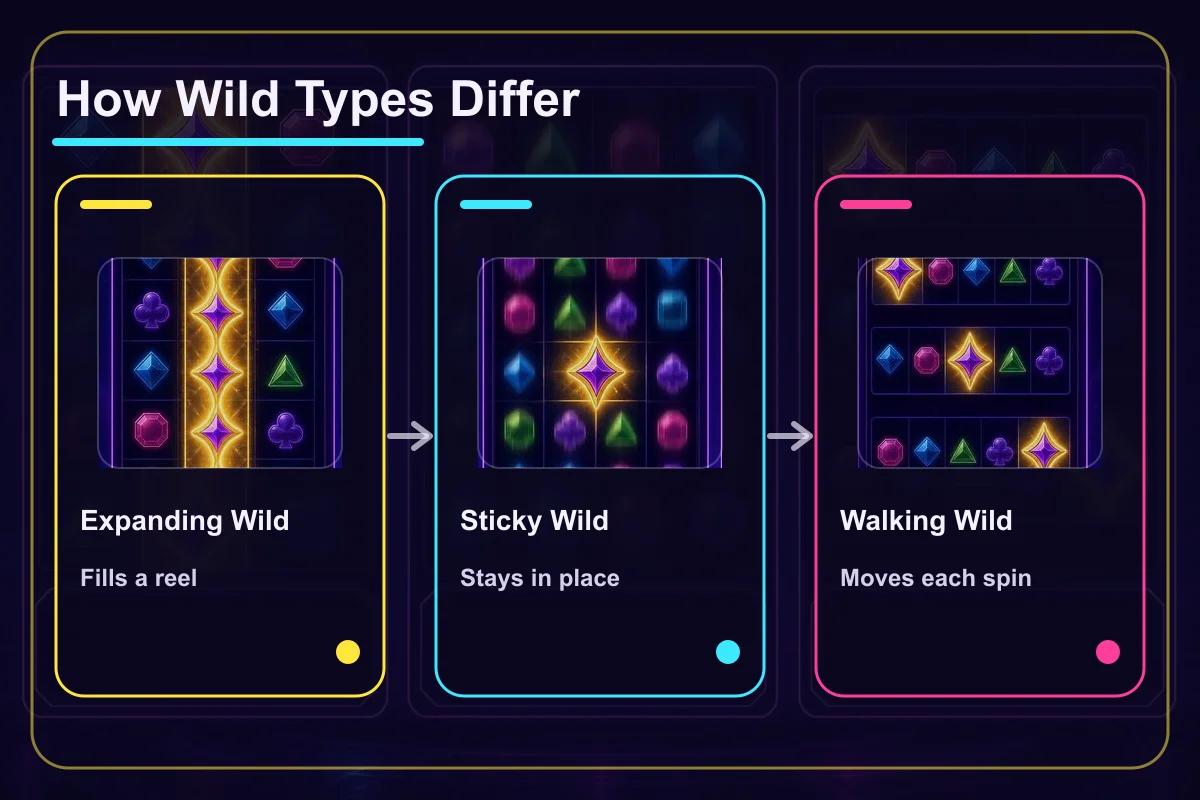
Wild types at a glance
| Type | What appears on screen | Rule to verify |
|---|---|---|
| Expanding Wild | The Wild covers more positions or a full reel | Expansion timing and eligible reels |
| Sticky Wild | The Wild remains while other positions spin | Number of rounds or feature duration |
| Walking Wild | The Wild moves between rounds | Direction, timing, and respin rule |
A single Wild can combine behaviours, such as a Sticky Wild with a multiplier. Read each layer separately instead of treating its main name as the complete feature.
A practical demo check
Choose a game with clearly published rules and leave Turbo off while learning:
- Read the complete Wild entry before spinning.
- Record eligible reels and game modes.
- Pause when the Wild appears.
- Separate substitution from expansion, persistence, or movement.
- If a respin begins, count rounds and track the original Wild.
- Stop at the planned time even if the feature did not appear.
A demo can show whether the sequence is understandable. A short sample cannot measure the true Wild frequency or predict the next result.
Before using real money elsewhere
Large full-reel symbols and repeated Sticky Wilds make a screen look powerful, but visual coverage does not guarantee a large award. Check the paytable and total stake again on the service you use because versions and settings can differ.
Set a time and loss limit before starting. Do not raise the stake because a Walking Wild seems close to the edge or a Sticky Wild has not appeared. Progress matters only when the rules explicitly store and display it.
Wild Types FAQ
Summary
Expanding Wilds cover more space, Sticky Wilds remain in place, and Walking Wilds move. Their exact timing and restrictions belong to each game’s paytable. Use demo mode to follow the sequence, not to estimate frequency or predict another spin.