
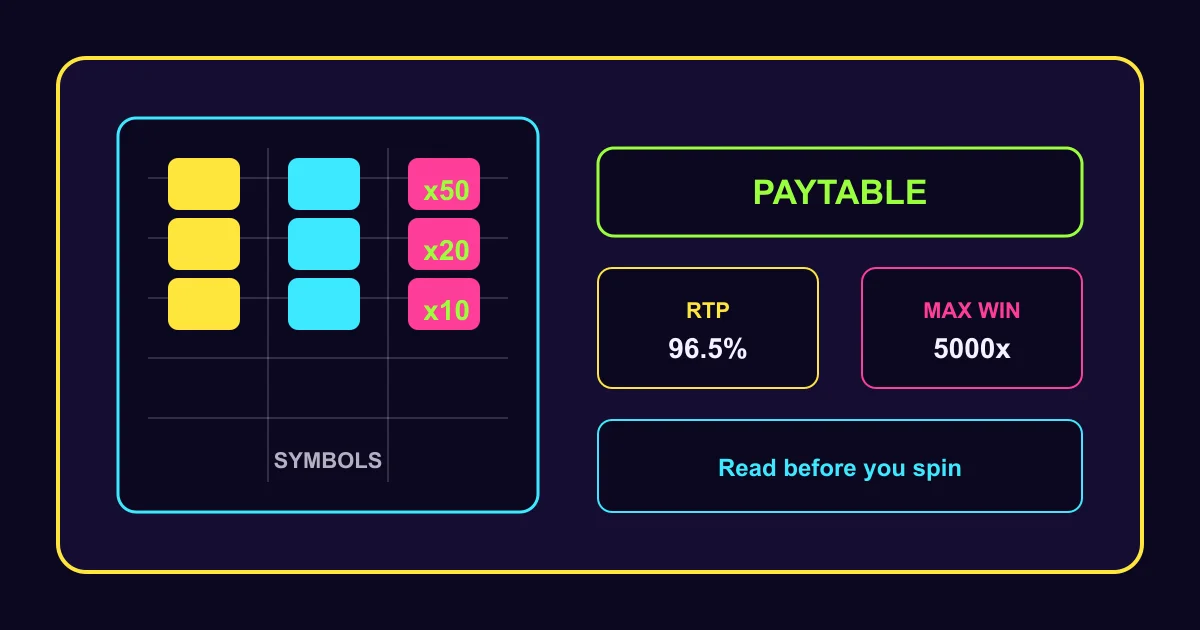
If you read slot reviews, watch highlight clips, or open demos on SlotLab, you will see the word paytable everywhere. Reviews say “check the paytable first.” RTP guides say “confirm RTP in the paytable.” Feature articles say “Wild behaviour follows the paytable.” Yet many players still treat it as a mystery button — usually an i or ? icon — without knowing what to read, how to read it, or why it matters more than pressing spin quickly.
A paytable is the rule book for that specific slot. It explains symbol payouts, Wild and Scatter behaviour, bonus triggers, the win system (paylines, ways, Megaways, cluster pays), and sometimes RTP or max win. Without it, you can watch beautiful animations and still not understand why one spin paid, another did not, or why a bonus paid the way it did.
This guide walks through paytables from the ground up: what they are, how to read each section, how to use them during SlotLab demo testing, and why you should read them before any real-money decision elsewhere. We are not telling you to trust the paytable instead of testing — but opening the paytable before your first spin is the best starting point for every new game.
This article was updated in May 2026 by the SlotLab editorial team, which regularly tests demos across multiple studios. Game examples link to real demos on the site, not copied review text from third parties.
What Is a Paytable?
A paytable is the in-game information screen that describes how a slot pays and how its features work. It is not a generic glossary that applies to every game. Fortune Tiger and Sweet Bonanza may both have scrollable info screens, but the rules inside are completely different.
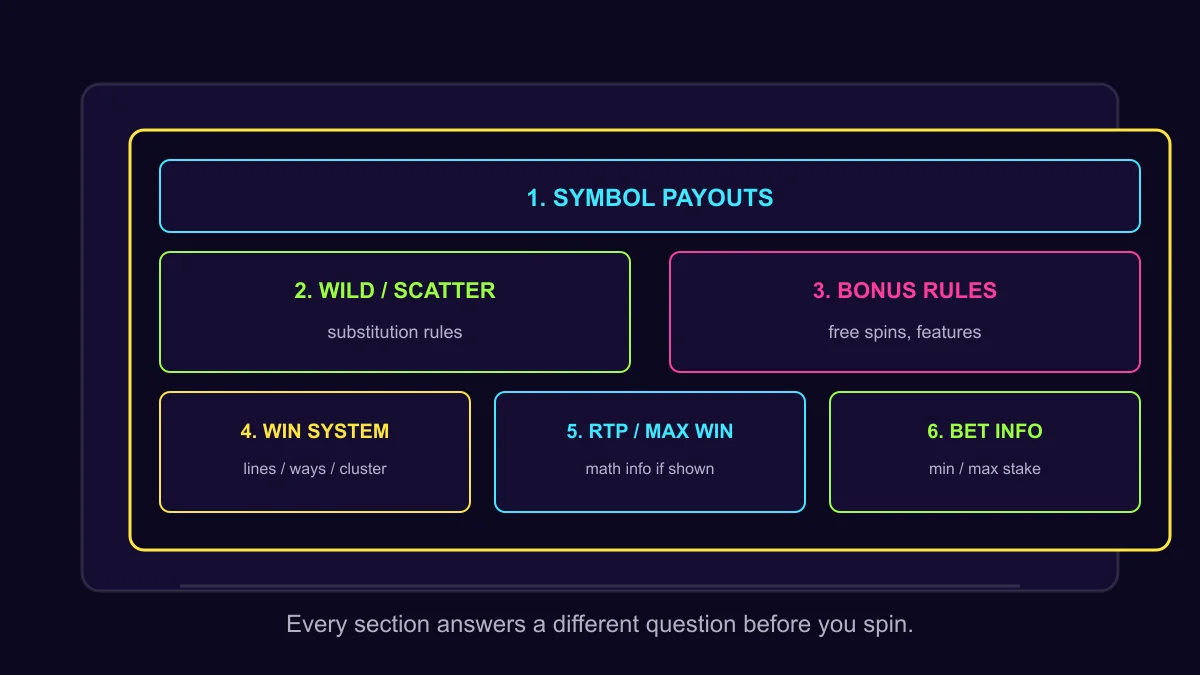
Most paytables cover at least three areas:
- Symbol payout values — what each symbol pays when it lands in a qualifying combination
- Special symbol rules — what Wild substitutes for, how Scatter triggers bonuses
- Feature conditions — free spins, multipliers, cascades, respins, or bonus buy if available
Some games add win-system details, RTP, max win, bet limits, and whether wins pay left-to-right only. That is why the paytable is often called the game’s “rule of law” — if the screen shows a result, the paytable should be able to explain it.
Where to Find the Paytable
Button placement varies by studio, but patterns repeat:
- i or ? icon — usually bottom-left or bottom-right on the main screen
- Hamburger menu (≡) on mobile — then “Paytable,” “Info,” or “Game Rules”
- Info button on the bet bar — common in PG Soft and Pragmatic Play titles
Once opened, the paytable may appear as a pop-up over the game or as a scrollable page. Most browser-based slots let you scroll on mobile, but text size and density differ a lot. Some games are comfortable to read; others require zooming.
On SlotLab, open the paytable on the device you actually play on. If it is hard to read on your phone, real-money play on that same device may feel equally frustrating. That is part of evaluating a game, not just judging artwork.
Main Paytable Sections You Should Know
Long or short, most paytables follow a similar structure. Knowing what each section answers helps you read faster.
Symbol payout table
This shows what each symbol pays when enough matching symbols land under the game’s rules. High-paying symbols usually appear first, followed by lower-paying icons. Numbers are typically multipliers of bet per line or per way, not fixed currency amounts.
Example: if the paytable says symbol A pays x50 for five of a kind, the win is 50 × the relevant bet unit — not “50 dollars” every time. Many players misread this and wonder why the on-screen win does not match the paytable number literally.
Wild, Scatter, and special symbols
Wild usually substitutes for regular symbols to help form wins, but the paytable specifies what Wild cannot replace — typically Scatter and dedicated bonus symbols.
Scatter often triggers free spins or a bonus, but conditions differ: three or four symbols, specific reels, separate scatter pays, retrigger rules. All of that lives in the paytable.
Other specials — floating multipliers, collectors, expanding wilds — must be read per game. Two slots can both say “multiplier” and behave differently. Gates of Olympus is a well-known tumble example, but its multiplier rules are not universal.
Win-system rules
The paytable tells you whether the game uses:
- Paylines — wins on predefined lines
- Ways — matching symbols on consecutive reels, usually left to right, without fixed lines
- Megaways — changing ways counts per spin
- Cluster Pays — wins from adjacent symbol groups
If these systems are new to you, read Paylines, Ways, Megaways, and Cluster Pays first, then return to the paytable of the game you are testing. That is faster than guessing from animations alone.
RTP, max win, and key game numbers
Not every game displays RTP in the paytable, but when it does, treat that figure as the main reference for the version you are playing. RTP is a long-term average, not a next-spin prediction — see What Is RTP? for context.
Max win (for example x5000 or x10000) is a theoretical ceiling, not a target. High max-win games often pair with higher volatility — see Slot Volatility.
Bet information and limits
The paytable or help screen often lists min/max bet, whether stake is per line or per total spin, and bonus-buy price and conditions where applicable.
How Paytables Differ by Studio
There is no single industry-standard layout, but studios have habits. Knowing the general pattern reduces surprise when you open a new title.
PG Soft — scrollable pages, large symbol art, clear ways-win explanations. Games like Mahjong Ways 2 usually read well on mobile. RTP often appears in the game info section.
Pragmatic Play — standard i button, separate paytable and game rules. Tumble games like Gates of Olympus explain multipliers and scatters across multiple paragraphs — read the multiplier section fully.
JILI and Fa Chai — on SlotLab these demos open in a new tab, but the paytable is still inside the game. Text can feel dense on small screens; test on your phone.
KINGMIDAS and Red Tiger — some games on SlotLab show RTP under the game name or in a stats box, but the number you should trust when playing for real money still lives in the in-game paytable. Always open the game and check the paytable again — do not rely on a single number from outside the game.
Whatever the studio, do not assume a new release from the same provider reuses the previous game’s paytable layout or rules.
Example: Reading a Payout in Your Head
Suppose the paytable says a top-tier symbol pays x20 for five of a kind on a ways slot, and your total virtual bet is 1.00 split across 20 ways (0.05 per way). The x20 value usually multiplies the relevant bet unit as defined in the paytable — some games spell out the formula clearly, others use shorter wording.
If you are unsure, watch the actual win amount after a hit and work backwards to the paytable. Doing that two or three times in demo mode teaches the game’s math faster than theory alone.
Step-by-Step: How to Read a Paytable
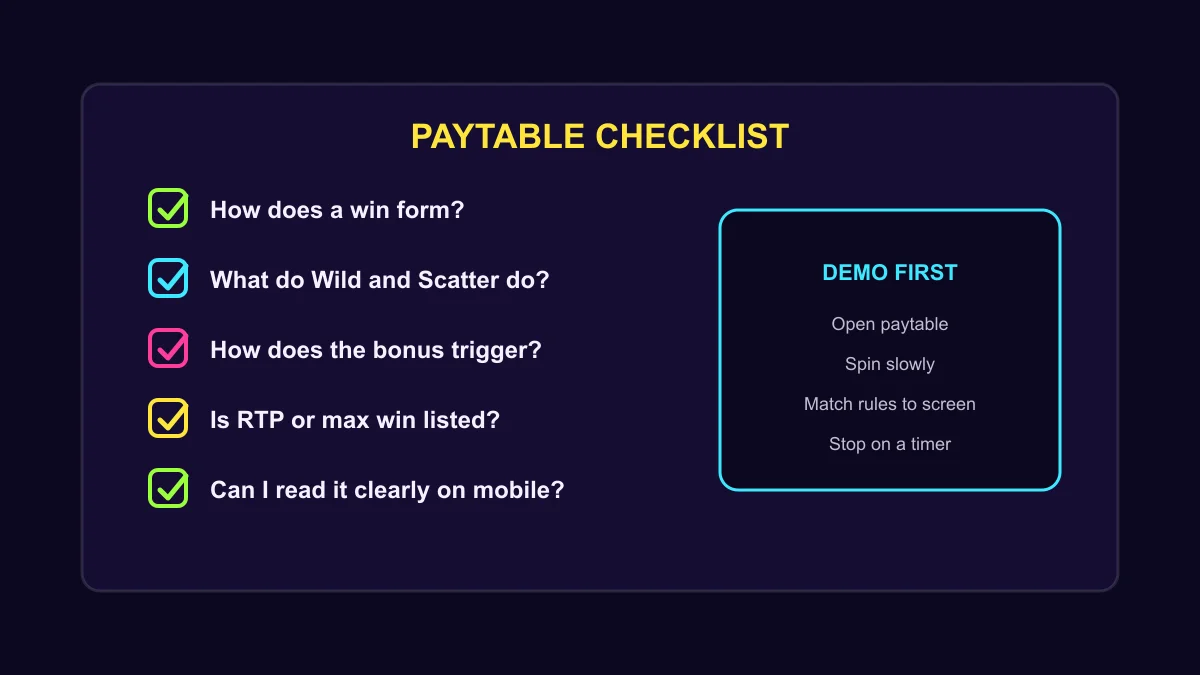
Step 1 — Ask “how does a win form?”
Read the win-system section first: paylines, ways, or clusters; starting reel; minimum count; both-ways pay or not.
Step 2 — Rank the symbols
Identify high-paying vs low-paying symbols. Top symbols usually drive the largest wins during regular play.
Step 3 — Read Wild and Scatter
What Wild replaces, which reels it can appear on, how many Scatters trigger the bonus, whether scatter pays separately.
Step 4 — Read bonus features
Free-spin count, retrigger rules, whether multipliers stack or reset, extra mechanics active only in the bonus.
Step 5 — Note RTP and max win if shown
Write them down for comparison, but remember RTP does not describe how a short test run will feel.
Step 6 — Match the screen
Spin slowly in demo and compare what you see to what you read. If something still makes no sense, reread the paytable before raising stake to “find out.”
Why You Should Read the Paytable Before Real-Money Play
The main reason is not that the paytable guarantees wins. It helps you decide with information and reduces expensive misunderstandings.
Fewer wrong conclusions from the screen
Slots are designed to feel exciting. Near-miss animations and “almost bonus” sound cues can suggest a win is “due.” The paytable makes no such promise — it only defines qualifying wins. When you know the rules, you are less likely to call a game “rigged” when the conditions simply were not met.
Fairer game comparison
Two games can look similar while paytables diverge. One may award ten free spins with a x2 multiplier; another fifteen spins with no multiplier. Without the paytable, you compare by feeling — and a short test run often gives a misleading picture.
Transparency check
A clear paytable with complete feature explanation and listed RTP (when available) supports better decisions than a vague one. If the paytable is unusually short, hides bonus conditions, or is unreadable, treat that as a warning in demo or real play.
Prepare before leaving SlotLab
SlotLab is a free slot demo site — no deposits, no withdrawals, no real payouts. Many players use it to learn before playing elsewhere. When you move to real money, open the paytable on that site again. RTP or some features may differ from the demo you tested.
Using the Paytable During SlotLab Demo Testing
Demo mode is the safest place to practice paytable reading. Try these steps:
Round 1: read only, do not rush spins
Open a game such as Mahjong Ways, open the paytable, and spend 5–10 minutes reading every section before spinning. Goal: explain how wins form, what Wild does, and how the bonus triggers.
Round 2: slow spins vs paytable
Use a low virtual stake and manual spins (avoid fast-spin mode at first). After each win or bonus, ask whether it matched the paytable. If not, reread the relevant section.
Round 3: one feature only
Pick one feature — free spins or multipliers — and test until you understand it. Do not try to master everything in one sitting. Pair with Free Spins, Wild, Scatter, and Multipliers if you want a feature overview.
Short notes after each test
Three lines: bonus frequency feel, paytable readability, fit for your style. Notes beat memory when comparing games.
Common Mistakes When Skipping the Paytable
Assuming a simple grid means simple rules — even 3×3 classics can hide bonus conditions.
Trusting highlight clips over the paytable — clips show lucky moments, not full rules.
Confusing paytable multipliers with on-screen totals — check what the multiplier applies to (per line, per way, or whole spin).
Treating near-miss as “almost bonus” — unless the paytable describes such a system, each spin is independent.
Skipping reread when switching sequels — Mahjong chapter 2, 3, and 4 are not identical rule sets.
Using external RTP instead of in-game paytable — review sites may cite a different version or market.
Paytable on Mobile vs Desktop
Same information, different reading experience. Mobile paytables may use smaller text, more scrolling, and tiny close buttons. Desktop often shows more at once.
Some SlotLab studios (JILI, Fa Chai, Red Tiger) open demos in a new tab, but the paytable remains inside the game. Confirm readability on your phone before judging real play on mobile.
If the paytable is hard to read, that may mean the game screen is not a good fit for your phone — not a demo-only issue.
Paytables and Responsible Play
Reading the paytable does not make gambling “safe” in the sense of guaranteed profit. It tells you what kind of game you are facing — volatility shape, bonus difficulty, multiplier ceiling. Understanding rules helps you set boundaries: time limits in demo, no impulsive bonus buys, no judging a game from one short test run.
SlotLab uses virtual credits only. If you play for real money elsewhere, set budget and stop rules in advance. Read Responsible Demo Testing and Demo Slots vs Real Money to separate what demo teaches from what real money adds emotionally.
Frequently Asked Questions About Paytables
Bottom Line: The Paytable Is the Best First Step
The paytable is not expert-only material. It is a basic tool every player should use. Whether you test Fortune Tiger on SlotLab or prepare for real play elsewhere, opening the paytable before the first spin helps you understand rules, compare games fairly, and avoid misreading exciting screen effects.
SlotLab offers free demos from many studios — no signup, no deposit. Take paytable reading seriously in demo, then spin slowly and match what you see to what you read. You will learn faster than mindless spinning and make better decisions if you choose to play for real money later.