
One slot title can be supplied in multiple RTP versions, but the active version should not move up and down after every spin. A provider can prepare several mathematical configurations. The operator version you open uses one of them, so the value inside that game’s paytable or Help screen matters more than a number copied from a review.
A provider page advertising an RTP “up to” a certain value may be showing the highest available configuration, not the setting used everywhere. The official HABANERO page for Hot Hot Fruit, for example, lists available RTPs of approximately 86%, 92%, 94%, 97%, and 98%. Source checked July 26, 2026.

How One Slot Can Have Several RTP Values
RTP, or Return to Player, is a theoretical long-term average over a very large amount of wagering. When a provider makes several versions, each configuration has its own mathematical return. The artwork, title, symbols, and feature names can remain the same.
Keep three values separate:
- Available provider configurations — every version the studio lists
- The value shown by a review or operator page — possibly a default or another market’s version
- The value inside your active paytable — the relevant figure for that session
If those sources disagree, rely on the information inside the exact game before risking real money. If the game does not disclose the value, ask the operator or choose a version with clearer information.
Does RTP Change After Every Spin?
RTP is not a live meter that rises after losses or falls after wins. A 96% version does not become a 94% version because you just won, and the game does not owe compensation after a losing run.
Individual results come from the game’s rules and random number generator. RTP describes the long-term design of the version. Switching to another approved configuration is different from the outcome of an individual spin.
Why Providers Offer Multiple Versions
Providers may support different markets and commercial arrangements with the same visible game. The mathematical distribution can differ while the interface and bonus theme remain familiar.
Differences may sit in:
- Base-game win frequency or value
- Weight assigned to free spins and bonus rounds
- Frequency of particular features
- Distribution between small wins and top outcomes
Do not guess which component changed unless the provider publishes it. The RTP difference is useful for comparison, while volatility and hit frequency describe different parts of the experience.
How to Find the Active RTP
Check before spinning:
- Open the information, Help, or paytable menu.
- Look for RTP, Return to Player, or Theoretical Return.
- Confirm the number is inside the game rules, not only on an external review.
- Record the value and date if you are comparing versions.
- If the value is missing, treat it as unknown instead of borrowing a number from the same title elsewhere.
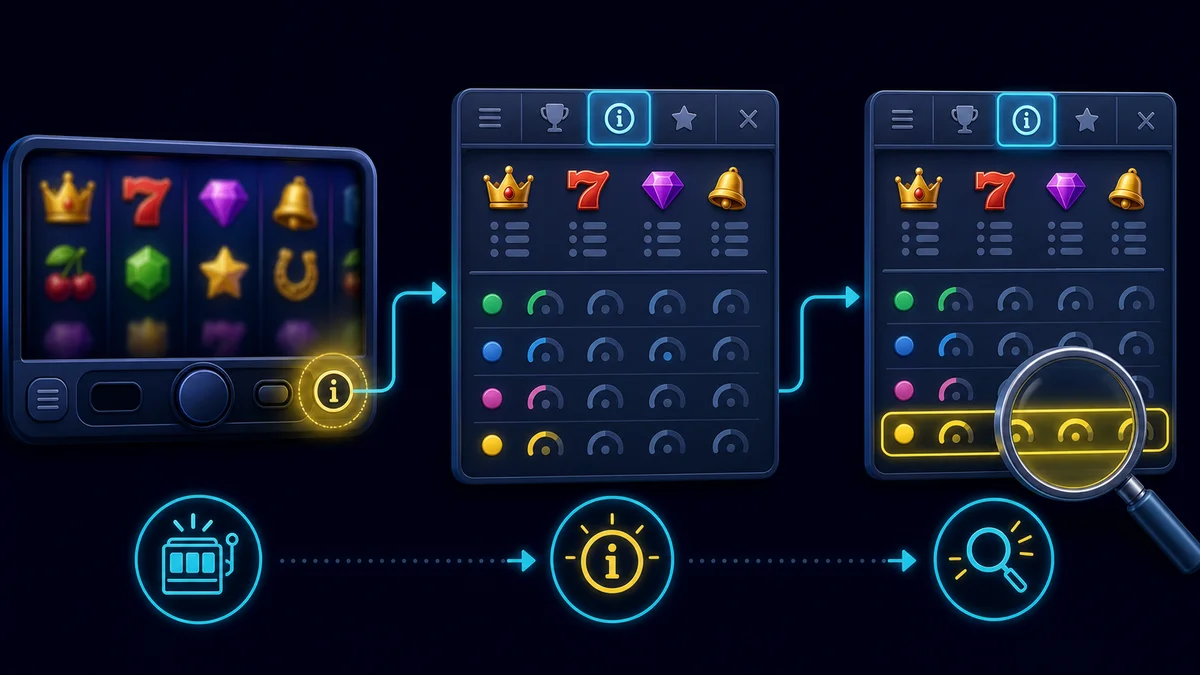
Mobile paytables may place the figure near the end of a long rules panel. Rotate the screen or scroll through every section. A phrase such as “high RTP” without a number is not enough for a precise comparison.
Must Demo and Real-Money RTP Match?
Do not assume they always match. A SlotLab demo helps you inspect the interface, paytable, features, and pace with virtual credits. A real-money operator elsewhere may launch another approved version or a market-specific configuration.
Open the information panel again on the real-money site before playing. Matching artwork and title do not prove that two sessions use the same RTP.
Does Higher RTP Mean an Immediate Win?
No. A higher RTP means a lower theoretical house edge over the long run. It does not forecast a short session. A higher-RTP version can lose repeatedly, and a lower-RTP version can still produce a large result.
Even a difference of several percentage points is a long-term difference. A test of 50 or 100 spins will not reliably display it because volatility can move short results far away from the theoretical average.
Can Demo Results Verify RTP?
A short demo cannot verify RTP. Even 100, 500, or 1,000 spins are tiny compared with the scale used to evaluate long-term game mathematics. One large bonus can pull the sample return far away from the stated average.
Demo mode is still useful for:
- Learning where the RTP appears
- Checking whether wager and win units are readable
- Separating RTP from volatility and maximum win
- Observing whether a losing run pushes you to increase the stake
Do not calculate one short session’s return and declare that the configured RTP is wrong. The result describes only that sample.
A Simple Version Comparison
Record rules, not lucky outcomes:
| Check | Version A | Version B |
|---|---|---|
| RTP inside paytable | Record from game | Record from game |
| Volatility | Use disclosed level | Use disclosed level |
| Total cost per spin | Record total | Record total |
| Optional mode | Off or on | Off or on |
| Date checked | Add date | Add date |
You can compare interface clarity with virtual credits, but do not rank versions by which one happened to finish ahead in a short test.
What If the Operator Does Not Show RTP?
Pause before using real money. Read every Help panel, check the provider’s game page, and ask the operator. If the value remains unavailable, you do not have enough information for a precise comparison.
Choosing a game that discloses its active value is simpler than filling the gap with a review number. The reviewer may have opened a different market, site, or approved configuration.
Multiple RTP Versions FAQ
Summary
A slot can exist in several RTP versions, but you need to identify which one is active. Do not automatically use the highest provider listing or a figure from an old review.
Open the paytable before spinning, record the value and date, and check again when you change sites. Demo mode is useful for learning where the information lives, but a few hundred or thousand spins cannot verify a long-term RTP.