
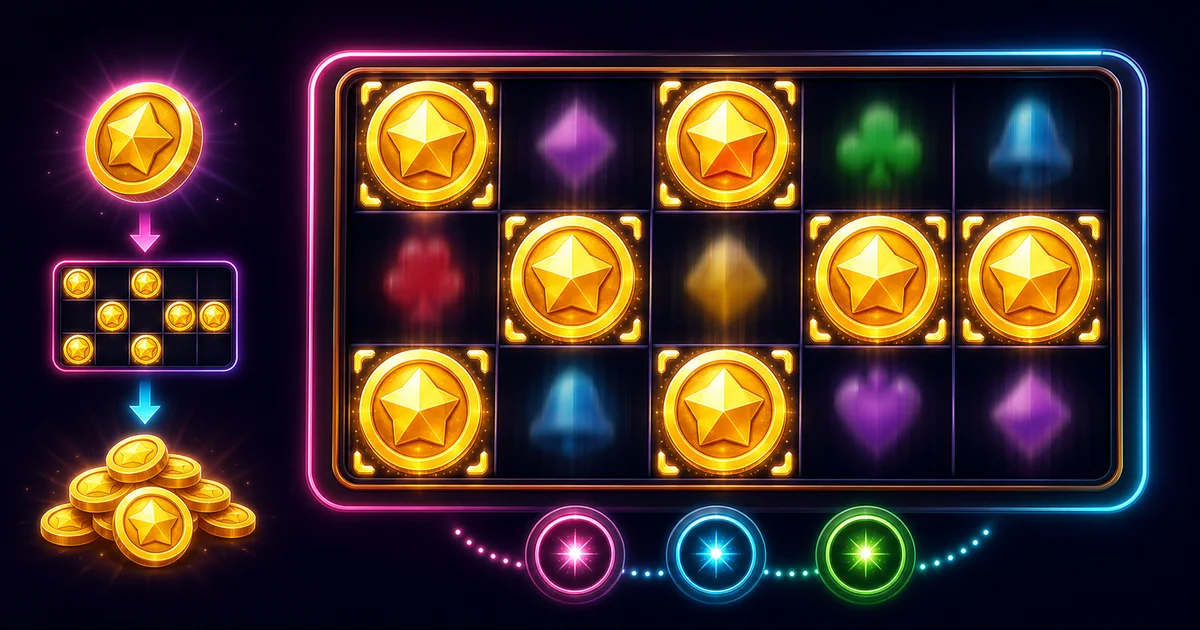
Hold and Win is a bonus round that locks special value symbols on a grid while the empty positions respin. The symbols are often coins, gems, or orbs carrying prize values. When the counter ends or the grid is filled, the game settles the collected values according to its own rules.
The same broad idea may appear as Hold & Win, Hold and Spin, Lock and Respin, Link & Win, or Money Respin. Those names do not guarantee identical rules. Evoplay’s explanation of the mechanic describes the classic version as locking value-bearing bonus symbols for the feature, while modern versions can add collectors, multipliers, wheels, pots, or expanding grids. Source checked July 26, 2026.
How Hold and Win Works
A classic round usually follows four stages:
- The required bonus symbols land in the base game.
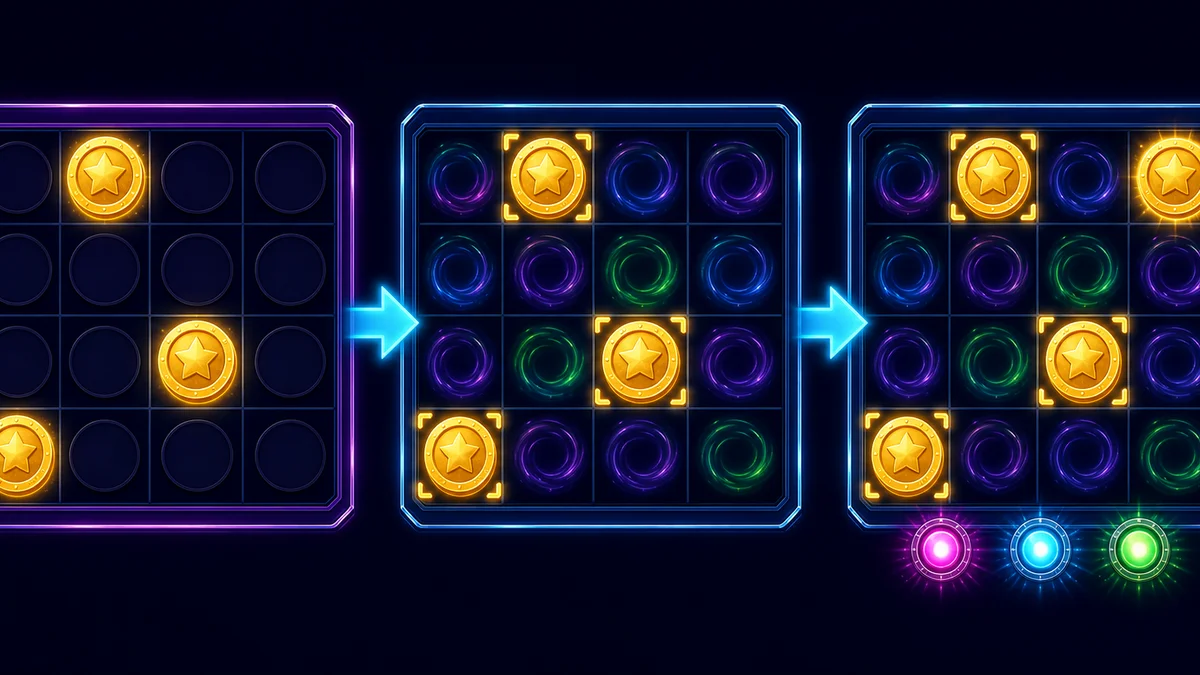
- The feature opens with those symbols locked on a dedicated grid.
- Empty positions respin and any new qualifying symbol locks in place.
- The round ends when the counter expires or the grid fills, then the game settles the result.
Many games restore the respin counter when a new symbol lands. Do not assume every title starts with the same number or uses a full reset. Some add only one spin, unlock extra rows, remove symbols after collection, or run several pots at once. The active paytable is the final reference.
What the Locked Symbols Are Worth
Value symbols do not behave the same way in every game. One title may show stake multipliers, another may display currency-equivalent values, and another may mix ordinary coins with Mini, Minor, Major, or Grand jackpot symbols.
Separate these elements when the feature begins:
- Ordinary value symbols
- Fixed or jackpot symbols
- Multipliers applying to one coin or the full total
- Collector symbols that gather other values
- Special positions that add respins or change the grid
Wait for the game’s settlement screen before adding the values yourself. If the interface shows cash values, check whether they change with the current stake. If it shows multipliers, confirm which bet amount they multiply.
Hold and Win vs a Regular Respin
A respin is any extra evaluation allowed by the rules. It might spin one reel again, keep a Wild in place, or give another attempt after a near trigger.
Hold and Win is a collection-focused type of respin. Value symbols normally stay on the board and the remaining positions continue spinning. A sticky-Wild respin that creates line wins without collecting coin values is not necessarily Hold and Win.
Hold and Win vs Free Spins and Bonus Buy
Free spins usually continue to evaluate regular symbols through paylines, ways, or clusters. Hold and Win commonly removes ordinary symbols and focuses on filling empty positions with value symbols.
Bonus Buy is an entry method, not a bonus type. A game can sell direct access to Hold and Win, free spins, or another feature. Buying entry does not guarantee a full grid or a strong result.
| Point | Hold and Win | Free Spins | Bonus Buy |
|---|---|---|---|
| Main action | Lock values and respin gaps | Run several bonus spins | Pay for feature entry |
| What to read | Coin values, counter, special cells | Wilds, scatters, multipliers | Price and exact destination |
| What is not promised | Full grid or jackpot | Large reward | Value for the price |
Does a Reset Counter Improve the Odds?
When the counter resets, the game is granting more respins under the feature rules. It does not necessarily improve the probability in each empty position, and it does not mean a Grand jackpot is due.
A board missing one symbol looks close to completion, but the next respin can still be empty. Treat that visual progress as interface state, not a reason to raise the stake or extend a session.
How to Test Hold and Win on SlotLab
Open a clearly labelled example such as Coin Tornado and use this checklist:
- Find the trigger requirement and starting counter in the paytable.
- Identify every symbol that can lock and how each one pays.
- Keep one virtual stake throughout the test.
- If the feature opens, follow the counter after every respin.
- Read the settlement screen and separate coin, multiplier, collector, and jackpot contributions.
Set a 15–20 minute limit. If the feature does not trigger, stop anyway. A longer wait does not make the game owe you a bonus. Demo mode can teach the interface and rules, but a short sample cannot establish the true trigger rate.
Who May Prefer This Mechanic?
Hold and Win gives visible progress because collected positions remain on screen. It may suit players who prefer a clear bonus objective and do not mind reading several symbol types.
It can also make stopping harder. A nearly full grid encourages the feeling that one more attempt should complete it. Use the demo to test your reaction: decide the stop time before opening the game and see whether you can follow it after a near-full round.
Checks Before Real-Money Play Elsewhere
- RTP and volatility in the active version
- Total stake after any optional mode is enabled
- Number and type of symbols required to trigger the feature
- Counter reset and end conditions
- Meaning of Mini, Minor, Major, and Grand
- Maximum award and any paytable limits
Set a budget, time limit, and stop rule in advance. Do not increase the stake to chase the last position. Previous demo outcomes and a nearly full board do not control the next result.
Hold and Win FAQ
Summary
Hold and Win becomes easier to read when you separate three questions: which symbols lock, what restores the counter, and how the game settles the values. Do not memorize one title’s trigger or respin count as a universal rule.
Read the paytable first, test with one virtual stake, and stop at the time you set. If you later play for real money elsewhere, verify the active RTP and rules again. A nearly full grid shows current progress; it does not promise that the next position will fill.