
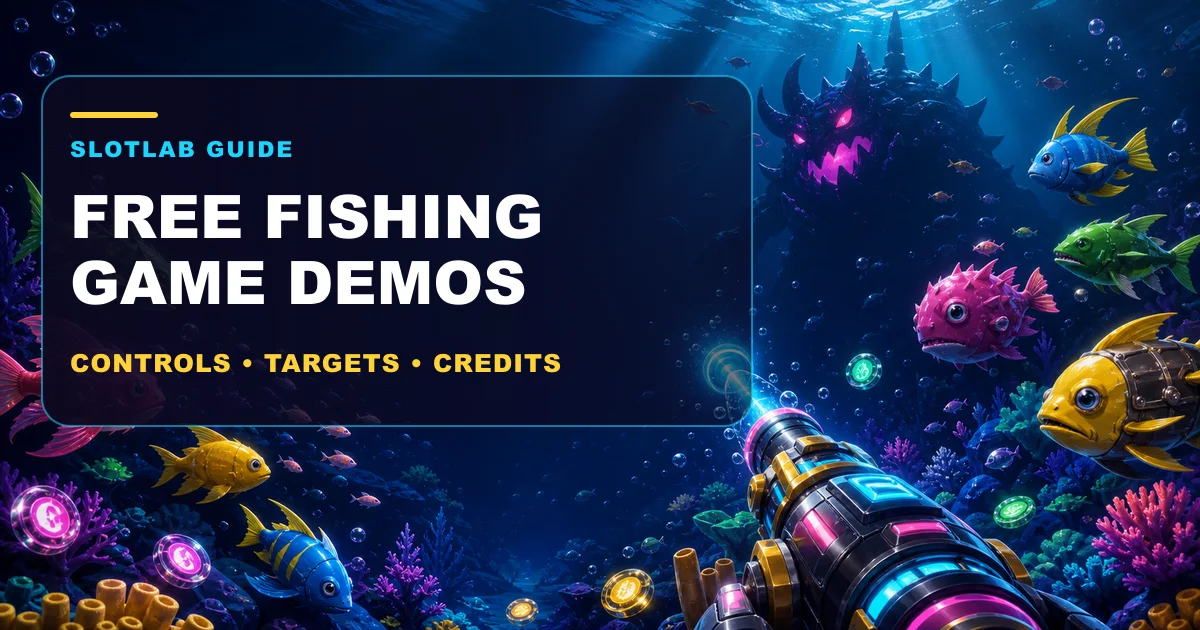
A fishing arcade game puts moving targets on the screen and a cannon along the edge. You choose a target, set the value of each shot, and fire. Every shot uses credits. Capturing a target adds a prize or starts a feature according to that game’s rules.
SlotLab fishing game demos use virtual credits. They require no SlotLab signup or deposit, and the balance cannot be withdrawn. The useful part is learning the controls, shot cost, target labels, and special features before real money is involved elsewhere.
Quick answer: Fishing games give you more visible choices than slots because you control the target, timing, and shot value. A well-aimed shot still does not guarantee a capture. Results depend on the rules and calculations of the game, so demo mode is a place to learn the screen rather than find a winning formula.
Jump to:
- How fishing arcade games work
- Fishing games versus slots
- What to read before firing
- Fishing demos available on SlotLab
- A 15-minute demo test
How Fishing Arcade Games Work
Fish, sea creatures, characters, or bosses move across the main screen. Your cannon points toward the position you tap or click. When you fire, the game deducts the selected shot value from the balance. A successful capture then awards credits or activates the feature attached to that target.
The screen resembles a skill-based arcade game, but aiming accurately does not make every hit successful. Some targets may take repeated shots, some trigger a separate event, and different games calculate outcomes differently. Open the Help or rules screen before assuming that the animation explains everything.
Most fishing games include several of these elements:
- Cannon or turret: aims and fires at moving targets.
- Shot value: shows the credit cost of one bullet. A game may display a stake number, a level, or a multiplier such as x1 or x2.
- Regular targets: smaller fish or creatures that appear frequently.
- Special targets: bosses, dragons, giant crabs, or creatures connected to a wheel, weapon, or jackpot.
- Target lock: follows one selected target automatically. Locking on does not guarantee a capture.
- Special weapons: railguns, bombs, nets, torpedoes, or free bullets earned under specific conditions.
- Meters and jackpots: track a separate feature according to the rules of that game.
- Credit balance: shows what each shot costs and which events add virtual prizes.
One title may let you select a special weapon. Another may award free bullets after a certain target is captured. A third may open a wheel after a feature event. Similar labels do not mean identical rules, so use the instructions inside the current game as the deciding source.
Fishing Games Versus Slots
A slot asks you to select a stake, press spin, and read the symbols when the reels stop. A fishing game lets you choose what to target and when to fire. That extra input makes fishing games feel more controlled, but it does not turn them into games where hand-eye coordination alone decides the result.
| Comparison | Fishing game | Slot |
|---|---|---|
| Main screen | Moving targets cross an arcade scene | Reels and symbols settle after each spin |
| Player choices | Target, firing time, shot value, and optional lock | Total bet, spin mode, and optional features |
| Cost | Each bullet deducts credits | Each spin deducts the total bet |
| Reading a result | Check the captured target and triggered feature | Check paylines, ways, clusters, or other win rules |
| Easy mistake | Holding fire until the balance falls too quickly | Using turbo or raising the bet without noticing |
If you normally play slots, the biggest adjustment is thinking in shots instead of spins. At a cost of 2 credits per bullet, 10 shots use 20 credits even if no target is captured. That calculation is obvious when you fire slowly and easy to miss when the cannon runs continuously.
Slot paytables often arrange symbol prizes in a table. Fishing games may show illustrated targets, multipliers, weapon explanations, and separate jackpot rules. Learn where the game displays the shot value, which page explains the targets, and where it defines each special event.
What to Read Before Firing
Do not begin by chasing the largest creature on the screen. Open the rules and locate the following six items first. A few quiet minutes here can prevent most confusion about where credits went.
1. Starting Balance
Note the approximate virtual balance and where it appears. You do not need a detailed spreadsheet. You only need a stable reference for the beginning of the test. If effects cover the number or it changes too quickly to follow, reduce the shot value and firing speed.
2. Cost Per Shot
Plus and minus controls near the cannon usually adjust the bullet value. Tap each control once and watch which number changes. Do not hold the fire button until you understand the cost. Fast games can release many bullets within a few seconds.
3. Target Values and Multipliers
A number beside a fish may show a target value or multiplier, but the rules must explain what it multiplies. Some games apply it to the shot value, while others reserve it for a separate event. Seeing x100 does not automatically mean that the result will add exactly 100 credits.
4. Target Lock and Automatic Fire
Target lock follows a moving creature. Automatic fire keeps the cannon shooting. Both reduce manual work and can also spend credits faster. Use manual shots during the first test so that you can see exactly when each bullet leaves and which target the cannon is following.
5. Special Weapons
Railguns, cannons, bombs, nets, and free bullets can come from different conditions. A weapon may require a particular capture, a filled meter, or a short timed event. Read how the weapon is earned and how it is used instead of judging it only by the final animation.
6. Bosses, Wheels, and Jackpots
Large targets do not follow one universal rule. One boss may open a wheel, another may build damage, and another may move the game into a separate mode. If the rules do not say that a higher shot value improves a specific result, do not assume that an expensive bullet offers better value.
Should You Shoot Small Fish or Large Targets?
There is no answer that applies to every fishing game. Small targets tend to cross the screen more often and are useful when learning how the cannon responds. Large creatures and bosses may connect to bigger multipliers, special weapons, or jackpots, but only the current game’s rules can explain the tradeoff.
During a first test, use smaller targets to check aim, touch sensitivity, and bullet cost. Once the controls make sense, lock onto one larger target and watch for a status bar, feature label, or new animation. This produces clearer information than firing at everything on the screen at once.
If a target leaves the screen, avoid chasing it because you have “already spent so many bullets.” Previous shots do not guarantee that the next one must complete the capture. The desire to recover spent credits is one of the easiest ways to continue beyond a planned limit.
Fishing Demos Available on SlotLab
These examples do not share one feature set. Compare two or three of them to see how studios handle targets, weapons, and bonus events rather than staying in one game for a long session.
JILI Jackpot Fishing
Jackpot Fishing is a clear starting point for learning common labels. JILI categorizes it as Fish and Arcade and lists a Jackpot Wheel, Jackpot Dragon, targeting, and lockdown controls. The official page gives a September 2019 publish date.
Find the target-lock control before firing continuously. Then watch how the game separates regular fish from jackpot events. If the wheel or dragon appears, read the feature label before focusing on the prize animation.
JILI Mega Fishing
Mega Fishing adds several distinctive weapons and targets. JILI lists a Special Octopus Wheel, Railgun, and Jewelry Turtle, together with a published maximum win of 950x. The official page dates the game to January 2021.
This is a useful demo for separating a weapon from a target. Check how the Railgun is obtained, when it becomes available, and what starts the octopus wheel. The 950x figure is a published upper limit, not an outcome that a short demo should be expected to reproduce.
JILI Ocean King Jackpot
Ocean King Jackpot uses the Rock Skeleton, Mermaid, King Crab, and Vampire multiplier as recognizable events. JILI says that the Vampire multiplier can reach x5 and dates the game to December 2023.
Watch whether the multiplier appears before or after a capture and how the game announces entry into a special mode. Do not apply x5 to every event yourself. It only works where the rules of that feature say it does.
FASTSPIN Bounty Fishing and Fishing Treasure
Bounty Fishing highlights Free Bullets, a jackpot, and boss targets. Fishing Treasure uses multiplier and feature controls differently. They make a useful mobile comparison because FASTSPIN says it designs its games around portrait mobile play.
Use the same virtual shot value and a similar time limit in both games. Compare how easily you can identify shot cost, important targets, and the reason a feature started. A demo that explains those three things clearly is more useful than one that merely produces a large short-term result.
Feature names and dates above come from official studio pages accessed July 17, 2026: JILI Jackpot Fishing, JILI Mega Fishing, JILI Ocean King Jackpot, FASTSPIN Bounty Fishing, and FASTSPIN Fishing Treasure.
A 15-Minute Fishing Game Demo Test
Fifteen minutes cannot prove that a game has a favorable capture rate or payout. It is enough time to check the controls, rule clarity, and speed of credit use. Divide the test into three simple blocks.
Minutes 1–5: Read and Fire Manually
Open Help and find the cost per shot, target values, target lock, and special-weapon conditions. Select the lowest available virtual shot value, then fire one bullet at a time. Keep automatic fire off while learning how the cannon moves.
Minutes 6–10: Keep One Shot Value
Try one regular target and one larger target without changing the bullet value. Watch how the screen shows a hit, whether a bar or label appears, and whether the credit balance remains readable. The goal is to understand the normal sequence, not force a jackpot event.
Minutes 11–15: Test One Control and Stop
Try either target lock or automatic fire, not both at once. If a special weapon becomes available, read its explanation before using it. At the end, answer three questions: Do you know the cost of one shot? Can you distinguish a special target from a regular one? Did you stop at the planned time?
If the answers are unclear, return to the rules or switch games. There is no need to continue until a rare feature appears. A demo that produces no large event in 15 minutes can still reveal whether normal play is understandable and comfortable.
What to Check on a Phone
Touch controls make aiming direct, but a small screen can hide important numbers. Hold the phone as you normally would and check where your thumb rests before starting continuous fire. The plus and minus controls should be far enough from the fire button that you are unlikely to raise the shot value accidentally.
Run these five checks:
- Tap a target near the screen edge and see whether the cannon follows accurately.
- Confirm that target lock, cancel, and automatic-fire controls are visually distinct.
- Make sure the balance and shot value remain readable during full-screen effects.
- Rotate the screen or switch tabs once, then confirm that the game resumes correctly.
- Lower the sound and check whether the visuals still explain a capture or feature.
Cramped buttons, tiny numbers, and effects that cover the balance are meaningful drawbacks. Free demo mode lets you find those problems before any real-money decision is involved.
What a Free Demo Can and Cannot Tell You
A demo answers usability questions well. You can learn whether the fire control feels comfortable, where the bullet value appears, how target lock behaves, and whether special events explain themselves. You can also compare two games with similar time and virtual-credit limits.
Short results cannot prove a capture rate, RTP, or future outcome. Capturing a boss quickly once does not make the game easy. Missing several targets does not mean a prize is due. Demo and real-money versions may share their core rules, but real money adds emotional pressure that virtual credits cannot reproduce. Read demo slots versus real-money slots and what RTP means for that distinction.
If you later open the game elsewhere, read that version’s rules again. Do not assume that bullet values, optional controls, or published settings are identical across every service. SlotLab demo results are not a signal that a target is “ready” to pay.
Learn the Screen Without Chasing Spent Bullets
Fishing games can use credits quickly because holding one button may release dozens of shots before you notice the balance. Set a time and virtual-credit limit before starting. Stop when either limit is reached, even if a boss remains on the screen or a meter looks almost full.
Take a break if you raise the bullet value after repeated misses, keep firing because earlier shots feel wasted, or assume that one target must pay soon. Those reactions matter more than choosing the “wrong” fish because they encourage more spending without adding useful information.
SlotLab has no real-money deposit or withdrawal system. Use a demo to learn the cost of each shot, test mobile controls, and find out whether you can stop comfortably at the planned point. Once those questions are answered, the test has done its job.