
The phrase easy-to-win slot appears everywhere in player discussions. Sometimes it means a game that produces small wins often. Sometimes it means a game where free spins seem to trigger quickly. Sometimes it means a demo session went well once and the player remembered the good result. The problem is that “easy to win” is not a standard game term, and it does not guarantee anything.
To use the phrase safely, separate player feeling from game information. A slot that looks active may still return many wins below the stake. A quieter slot may place more value in free spins or multipliers. A game someone else likes may not fit your budget, attention span, or risk tolerance.
This guide explains how to evaluate “easy-to-win” claims using RTP, hit frequency, slot volatility, paytables, and max win before making any real-money decision elsewhere.
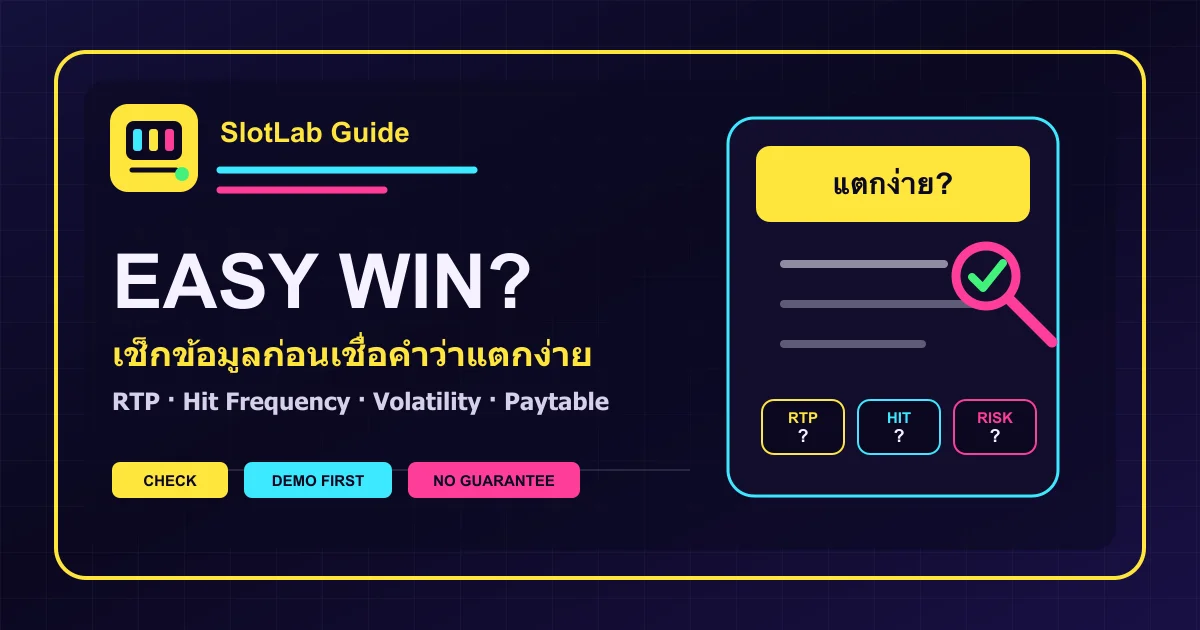
What Players Usually Mean by Easy to Win
Players use “easy to win” for several different experiences:
| What someone may mean | Better question to ask |
|---|---|
| Wins appear often | Are those wins above the stake or only partial returns? |
| Free spins trigger quickly | What happens when the feature starts? |
| A demo session paid well | How many spins were tested, and was it only a short run? |
| The game is popular | Is there paytable information, or only word of mouth? |
| RTP looks high | What are the volatility and bonus structure? |
Without those follow-up questions, “easy to win” becomes too vague. It can make a game sound safer or more predictable than it really is, especially when you are seeing only highlight clips or screenshots of strong results.
Why Easy to Win Is Not a Promise
Slots run spin by spin. A quiet stretch does not mean the next spin is due to pay, and a good demo result does not mean a real-money session elsewhere will behave the same way.
Useful information comes from the game itself: RTP, volatility, max win, bonus rules, how many Scatters trigger free spins, what Wilds do, and whether the game uses paylines, ways, Megaways, or Cluster Pays. These details do not predict the next spin either, but they help you understand how the game is designed.
Treat “easy to win” as a reason to check the game, not as proof. Open the demo, read the paytable, and test with virtual credits before risking real money anywhere else.
Start With RTP, But Never Stop There
RTP is the long-term average return built into a game. An RTP near 96% does not mean you will get 96 back from every 100 in a short session. It describes a long-term mathematical average over a very large number of wagers.
RTP helps compare games, but it does not tell you whether wins feel frequent, whether bonuses are hard to trigger, or whether the rhythm suits you. Two slots can have similar RTP and feel completely different. One may create many small base-game wins. Another may stay quiet and concentrate more value in features.
Read RTP alongside:
- Low, medium, or high volatility
- Hit frequency if the game shows it
- Max win and prize structure
- Bonus triggers and multipliers
- Minimum stake and mobile readability
If a game does not show RTP clearly, use demo play to judge rules and comfort, but do not invent a number.
Hit Frequency Explains “Pays Often”
When someone says a slot pays often, think about hit frequency. Hit frequency describes how often a slot produces a paying result. The important catch is that a paying result can still be smaller than the stake.
If you bet 10 virtual credits and win 3, the spin produced a hit, but the balance still fell by 7. A high-hit-frequency slot can feel active while slowly reducing the balance.
When comparing games, track separately:
- Spins with any win
- Spins with a win above the stake
- Spins that trigger free spins or a bonus
- Spins where multipliers or special features actually matter
This keeps sound effects and animations from misleading you. Some slots celebrate small wins very well, even when the balance barely improves.
Volatility Shows How Swingy the Game Feels
Volatility describes how strongly results can swing. Lower-volatility slots often show smaller wins more frequently. Higher-volatility slots can have longer quiet stretches and more value placed in rarer features.
If you like steady feedback, lower or medium volatility may feel easier to read. If you enjoy chasing feature rounds, multipliers, or larger max-win potential, higher-volatility games may interest you, but the quiet stretches are part of the design.
The phrase “easy to win” often hides this tradeoff. A high-volatility slot may appear in big-win clips because the best moments look exciting, but those clips rarely show all the empty spins before the highlight.
Max Win Is a Ceiling, Not a Probability
Max win is the highest possible prize the game defines, often written as a multiplier of stake such as x5,000 or x10,000. It tells you the ceiling, not how often that ceiling is reached.
High max-win slots often need several conditions to line up: free spins, stacked multipliers, specific symbols, or special bonus states. A large number can be exciting, but it does not mean the slot is easy to win.
Use max win as one piece of context. Read how the game can reach that number and whether meaningful smaller wins exist along the way.
How to Test an “Easy-to-Win” Claim on SlotLab
Demo mode is useful because you can compare rhythm without risking real money. Test with structure instead of spinning quickly and remembering only the best result.
Try this:
- Pick three games people often mention, such as Fortune Tiger, Mahjong Ways 2, and Gates of Olympus
- Open the paytable before spinning
- Use the same virtual stake in every game
- Run 100 slow virtual spins per game
- Note any-win hits, wins above stake, and bonus triggers
- After each game, write whether it felt readable, whether it pushed you to raise stake, and whether the rhythm suited you
One hundred spins cannot prove the true mathematics of a slot. It can help you compare feel and understand your own reactions better than a vague claim.
Warning Signs in Easy-Win Claims
Be careful when you see claims such as:
- Guaranteed win
- Bonus formula
- This round must pay
- The game is releasing
- Follow this and withdraw
- Guaranteed profit
Those claims go beyond what a paytable or demo session can prove. Demo play helps you learn rules, pacing, mobile layout, and feature behavior. It does not guarantee real-money results.
SlotLab does not accept deposits, does not pay real-money prizes, and does not sell winning systems. The demos are for learning with virtual credits only.
Choose Fit, Not Hype
A game that suits one player may be wrong for another. Newer players may prefer a readable paytable, clear buttons, and enough small events to understand the game. Players who enjoy feature hunting may prefer medium or higher volatility, but they still need clear stop rules when using real money elsewhere.
Before choosing a slot, ask:
- Do I understand the main rules?
- Does the game make me want to raise stake too quickly?
- Are bonus rules readable when they trigger?
- Is the mobile layout comfortable?
- If I play for real money elsewhere, have I already set a budget and stop point?
If several answers are unclear, keep testing in demo mode. There is no reason to rush into real-money risk because someone called a game easy to win.