
Cluster Pays is a slot win system where matching symbols pay when they touch as a group. The symbols do not need to sit on a fixed payline, and they do not usually need to connect from the leftmost reel like ways wins.
Many Cluster Pays games use candy, gem, puzzle, or board-style layouts. A game might require 5, 8, 10, or another minimum number of matching symbols in a cluster before it pays.
This guide explains how clusters work, how they differ from paylines and ways, and how to test the rules with virtual credits before making any real-money decision elsewhere.
How Cluster Pays Works
The game checks whether matching symbols touch each other. Most games count horizontal and vertical connections. Some may define connections differently, so the paytable matters.
For example, if a paytable says that 8 matching crystal symbols create a cluster win, the game pays when at least 8 crystals touch as a group. They do not have to form a straight line.
The key questions are the minimum cluster size, which directions count as touching, and whether bigger clusters pay more. These answers should be in the paytable.
Cluster Pays vs Paylines vs Ways
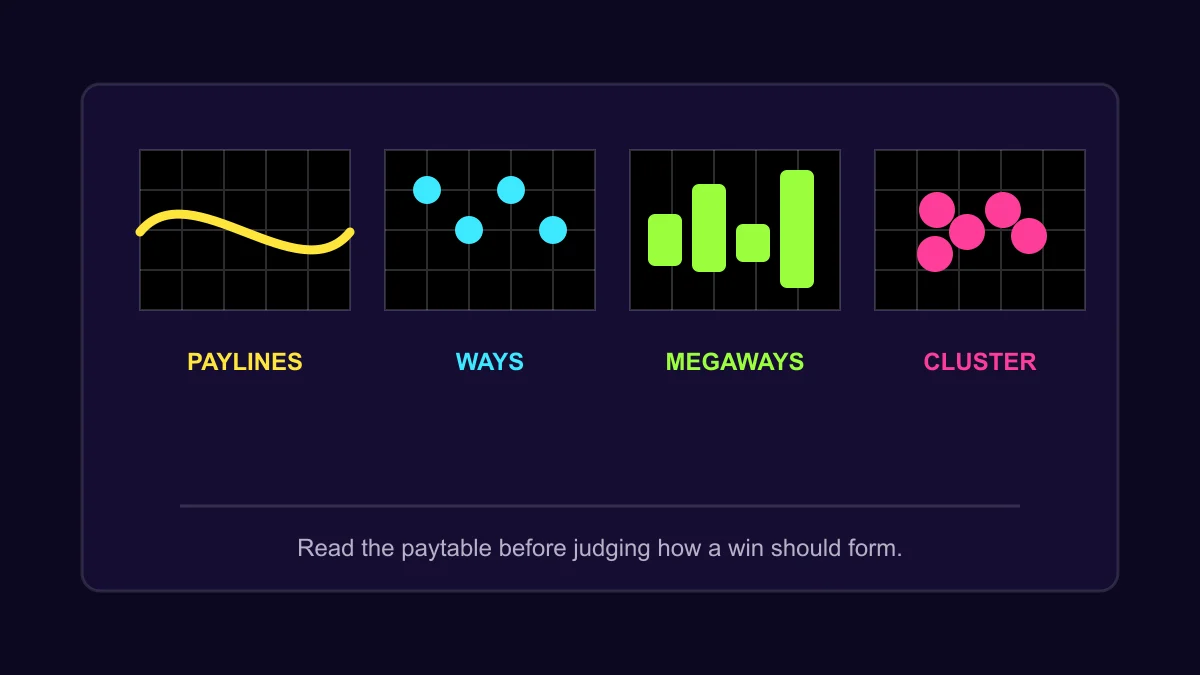
Paylines check fixed paths. Ways check matching symbols across consecutive reels. Cluster Pays checks groups of matching symbols anywhere on the board, according to the game’s rules.
In practice:
- paylines feel linear and easy to trace
- ways feel reel-to-reel
- cluster games feel more like board or puzzle wins
Cluster Pays can be satisfying because wins may form in the middle, top, or bottom of the screen. The tradeoff is that players need to learn the minimum cluster size and how the game counts touching symbols.
Cluster Pays and Cascades
Cluster Pays often appears with cascade, tumble, or avalanche mechanics. When a cluster wins, those symbols disappear and new symbols fall into place. If the new symbols form another cluster, the game may pay again in the same spin.
These terms are related but not identical:
- Cluster Pays is the way wins are counted
- cascade or tumble describes symbols disappearing and falling
- avalanche is another name some studios use for similar movement
A slot can have cascades without being a Cluster Pays game. Read the paytable rather than relying on animation alone.
Sanctuary of Magic is a useful SlotLab demo example because its data identifies Cluster Pays and cascading-style feature pacing.
How to Test Cluster Pays in Demo Mode
Start with the paytable. Find the minimum number of symbols required for a cluster and check whether the game shows examples.
Then spin slowly. When a cluster pays, count the symbols and see how the game highlights the group. If symbols disappear and new symbols fall, watch whether multipliers or bonus meters change.
Avoid judging from near misses. A group that looks close is still not a win unless it reaches the required size and connection rule. Slot animations can make the screen feel close to a large hit, but the paytable decides the result.
Who Might Like Cluster Pays?
Cluster Pays can suit players who enjoy board-style slots, cascading reactions, and non-linear win patterns. If you prefer simple line tracing and quick results, payline slots may feel clearer.
The system does not guarantee higher returns. Cluster games can be low, medium, or high volatility depending on symbol values, bonus rules, multipliers, and RTP.
Bottom Line
Cluster Pays slots award wins from groups of matching symbols. They are different from paylines and ways because they focus on symbol clusters rather than fixed paths or reel-to-reel connections. Use demo mode to learn the minimum cluster size, connection rules, cascades, and bonus behavior before deciding if the format fits your style.